From Policy Change to Action: Why Timing Matters in Insurance
We’ve heard people in mortgage servicing use verification and tracking as if they’re interchangeable, and honestly, for a lot of daily work, treating them that way doesn’t break anything.


LenderDock provides real-time, insurance policy details through its magical web portal or its APIs.

LIENSure sends corrections digitally, straight from the financial source of truth and in bulk for easy processing.

ESCROWPay verifies what’s actually due before the money moves, then sends the payment and reconciliation data digitally.

NOTiFi delivers required policy, coverage, and billing notices in the formats lienholders actually use
At least check out the genesis of LenderDock Video. It’ll all make sense, the eco-system, that is.
Learn more about our great leadership team and our amazing, people-first, company culture.
There’s a lot going on at LenderDock and in our industries. We threw it all here to make it easier to keep up.
We go to a lot of events and we love to eat. See our calendar of where we’ll be.
New webinars will be coming quite frequently. Educational, success, and sales.
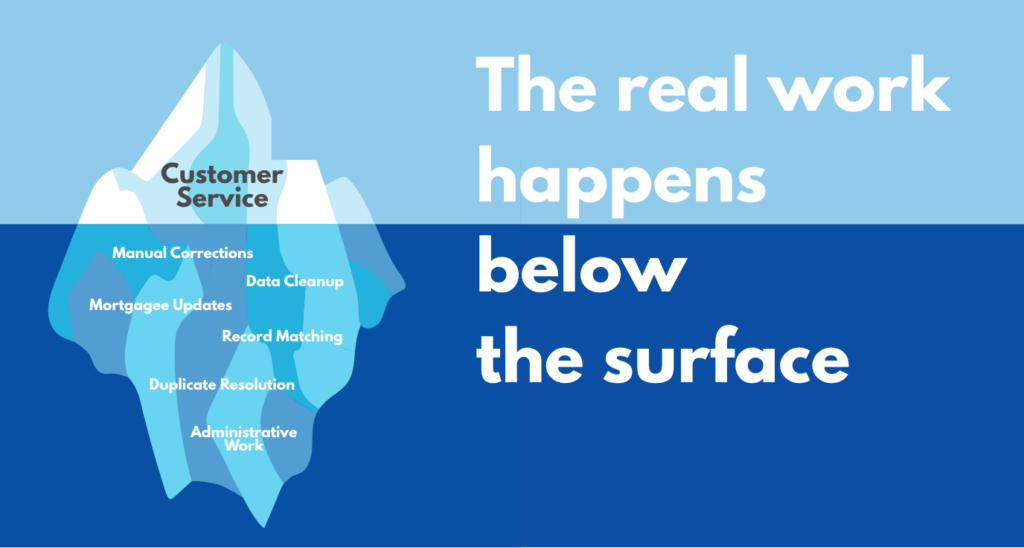
There is a version of customer service that most insurance companies describe in their annual reports and marketing materials. Knowledgeable representatives, fast resolutions, proactive communication, a team focused on making things easier for the people they serve.
Then there is what those teams actually spend most of their day doing.
A significant portion of insurance customer service work has nothing to do with serving customers in any meaningful sense. It is data work. Reconciling a coverage detail that does not match between the carrier’s system and the agent’s records. Confirming a policy status that should already be visible to the person asking but is not, because the system they are looking at has not been updated yet. Reissuing a document because the version on file has the wrong mortgagee name.
None of this required a customer service representative in any logical sense. It required accurate data, delivered to the right place, at the right time. The representative is there because the data was not.
The way this accumulates is worth understanding. Each individual task is small. A correction takes a few minutes. A verification call does take longer but not much. A document reissue adds some back-and-forth but eventually resolves.
The problem is volume.
Across a large carrier or servicer operation, these small tasks arrive continuously, and the teams handling them spend a meaningful share of their working hours on work that exists purely because information moved incorrectly or incompletely somewhere upstream.
The customer experience on the other end of this is its own problem. A borrower calling to confirm their insurance is active does not know they have reached a team whose day is largely structured around compensating for data gaps. They experience wait times, transfers, requests to call back, and in some cases contradictory answers depending on which system the representative happens to be looking at. The frustration is real even though nobody on either side of the call is doing anything wrong. The system is just working exactly as it was designed, which is the part worth paying attention to.
Data errors in insurance tend to originate in a small number of predictable places. Lienholder information is one of the most common sources (the same financial institution appearing under dozens of slightly different names and addresses across carrier systems, which means notifications and documents routinely go to the wrong place or worse fail to arrive at all!).
Policy updates that get entered in one system but do not propagate correctly to the others connected to it are another. Manual data entry at any point in the workflow introduces the possibility of an error that will require human effort to find and fix later.
The irony is that most of the information needed to prevent these errors already exists somewhere in the ecosystem. The correct lienholder address is in the servicer’s system. The accurate policy status is in the carrier’s system. The updated coverage details are in the agent’s platform. The data is there. It is just not moving between systems reliably enough, or quickly enough, to prevent the downstream failures that customer service teams then spend their time resolving.
Automation and real-time data exchange have reduced this problem in the organizations that have invested in them. When a lienholder can submit a correction directly through a digital platform (rather than calling a service line and waiting for a representative to manually update the record), the correction happens faster, more accurately, and without consuming anyone’s time on either end of the process.
When policy updates propagate across connected systems the moment they occur, the verification calls asking whether a change has taken effect largely stop, because the answer is already visible to whoever is asking.
What tends to hold this back is not a shortage of available solutions but rather the accumulated assumption that data cleanup is just part of the job, a background cost of running an insurance operation that has always been there and will always be there. Teams get sized around it. Workflows get built around it.
And because it is distributed across enough people and enough small tasks that no single number ever captures the full cost, it rarely gets treated as the operational problem it actually is.
The representatives answering those calls are not the inefficiency. They are the symptom of one.

We’ve heard people in mortgage servicing use verification and tracking as if they’re interchangeable, and honestly, for a lot of daily work, treating them that way doesn’t break anything.
A two-day lag between a policy change and everyone finding out about it used to be annoying, not dangerous. Someone made a call, waited, got an answer, and moved on with their day.

We’ve heard people in mortgage servicing use verification and tracking as if they’re interchangeable, and honestly, for a lot of daily work, treating them that way doesn’t break anything.

Insurance verification is a routine part of the lending and insurance process. A lender needs to know whether a policy is active. A mortgage servicer may need to confirm coverage or mortgagee information. An insurance…

In the earliest version of insurance verification, the person answering the phone actually had to know things. They pulled a physical file, checked handwriting against a ledger, and made a judgment call about whether what…

Two insurers can each have perfectly accurate, well-maintained policy databases and still fail to exchange a single piece of usable data between them.

Every single day, insurance workers face a mountain of simple questions. Are they tired of answering the same questions about policy coverage all day long? Yes, they are. When banks or lenders need to check…
A title company closing a home sale needs to confirm the seller’s policy is active before the deal can move. An auto lender needs the same thing before releasing funds on a car loan. A…

Most people who take out a mortgage never think about insurance as part of the loan itself. It feels adjacent, a separate purchase, something the lender requires but does not really participate in beyond checking…

Mortgagee corrections are a routine part of insurance servicing, but the process behind them is often anything but simple. A lender may find that the mortgagee’s name or address on a policy is out of…



We consectetur adipiscing elit tempor incididunt ut labore. Wondering ipsum dolor sit amet? We consectetur adipiscing ipsum nulla glavrida elit tempor incididunt.